LumenCache in a Custom Home: Low-Voltage Lighting, Fans, and Devices
UrbanLUX has installed LumenCache in close to 30 custom homes. Why we spec this low-voltage DC platform for lighting, fans, and devices, and why it looks like the future of new-home wiring.


I installed LumenCache in an 8,800 square foot house with 320 light fixtures, 11 ceiling fans, and 13 exhaust fans. All of those devices running at the same time use a little more energy than a hair dryer. The whole system can be backed up with an alarm battery.
That is what a low-voltage DC system looks like when the house is full of LEDs and DC devices instead of line-voltage cable to every fixture. UrbanLUX has put LumenCache in close to 30 custom homes in and around San Antonio and the Hill Country over the last 5 years. We started on Gen 1, then known as LibRE. We are installing ReNetA now. We buy it, we pull it, and we keep putting it in the next house. If another builder around San Antonio or Central Texas wants the same system, we want to install it for them.
If you are building a custom home and you still plan to feed LED lighting with traditional 12/2 or 14/2 wire, then talk to me about this system first.
What LumenCache is
LumenCache is a low-voltage DC network for lighting and devices. Power and data run on Cat5/6 to a central panel. Drivers live in that panel, not in a light you cannot reach in a 20' ceiling. Fixtures and devices get the voltage they need. One conversion at the panel instead of a driver stuffed in every fixture.
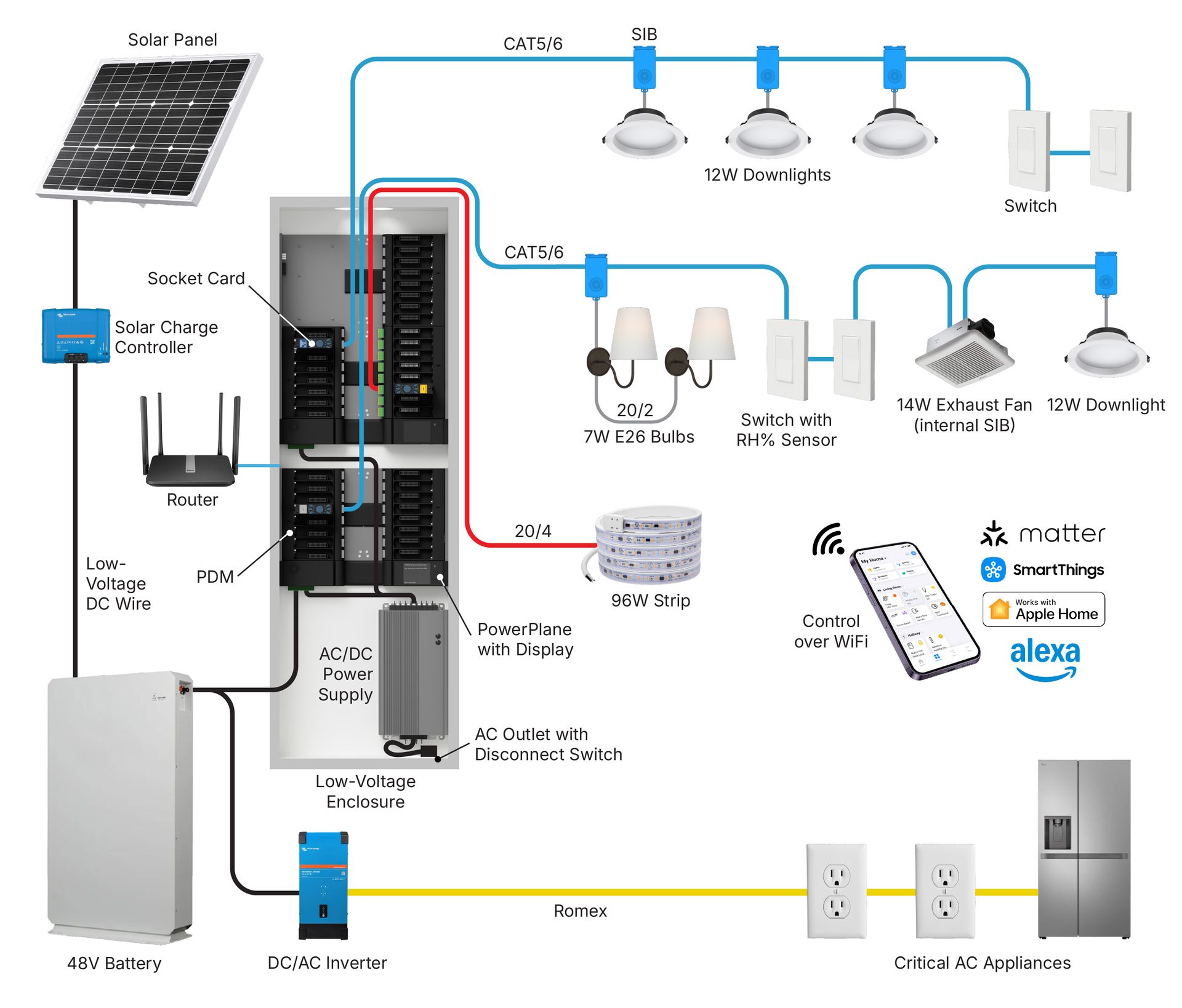
The current residential and commercial platform is ReNetA, their Gen 2 architecture, after over a decade of Gen 1 and LibRE in the field proving the concept and system. The hardware is modular: a PowerPlane in a low-voltage enclosure, Power Distribution Modules that accept socket cards, and Smart Interface Blocks at the fixtures. Plug in the card that matches the load. Downlights, tapelights, DALI, PoE cameras, 12V and 24V, occupancy and temperature sensors. Same system. Who they are is on their about page. We will keep installing it.
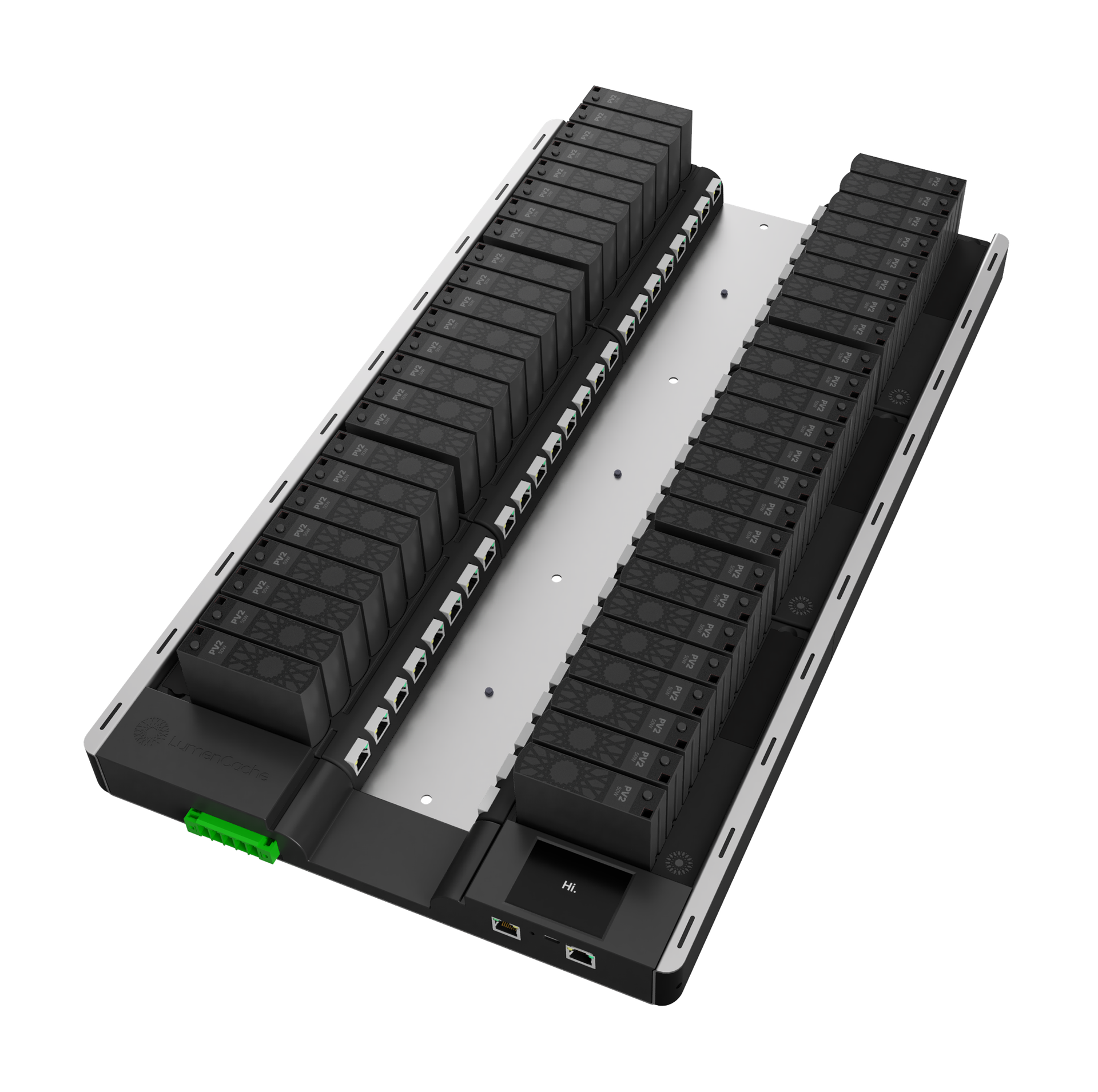
Derek Cowburn, who founded the company, put the physics in one sentence on their site: LED lighting sips electricity, so why do we deliver power to lights with a firehose? That is the whole argument. LEDs are DC devices. Ceiling fans and exhaust fans have DC versions. Charging outlets, TVs, computers, cameras, and sensors do not need a 120-volt circuit. Running line voltage to them is waste. Copper, labor, heat, and a driver at every fixture that will fail years before the LED chip does.
LumenCache's own technology page is a Class 2 platform: plug-and-play, fault-managed power, battery-backed sensors, open to the brands you already specify. We have watched that hold up on real houses. The components last longer than the retrofit LED stuff from a big-box store or a supply house.
Ninety percent less copper is a feature
Ninety percent less copper is a feature of how the system is built. Cat5/6 carries power and data. You are not pulling 14/2 lighting circuits to every can, tape run, fan, and device. LEDs do not need line voltage. Using line voltage for them is a waste.
On their builder article, LumenCache also talks about offloading lighting and low-voltage loads from the AC panel. One AC circuit feeds the low-voltage panel. The rest of the lighting layer is structured cable. That matters on a custom house that is already eating panel space for HVAC, a well, a pool, EV, and solar. Lighting should not be competing for those slots.
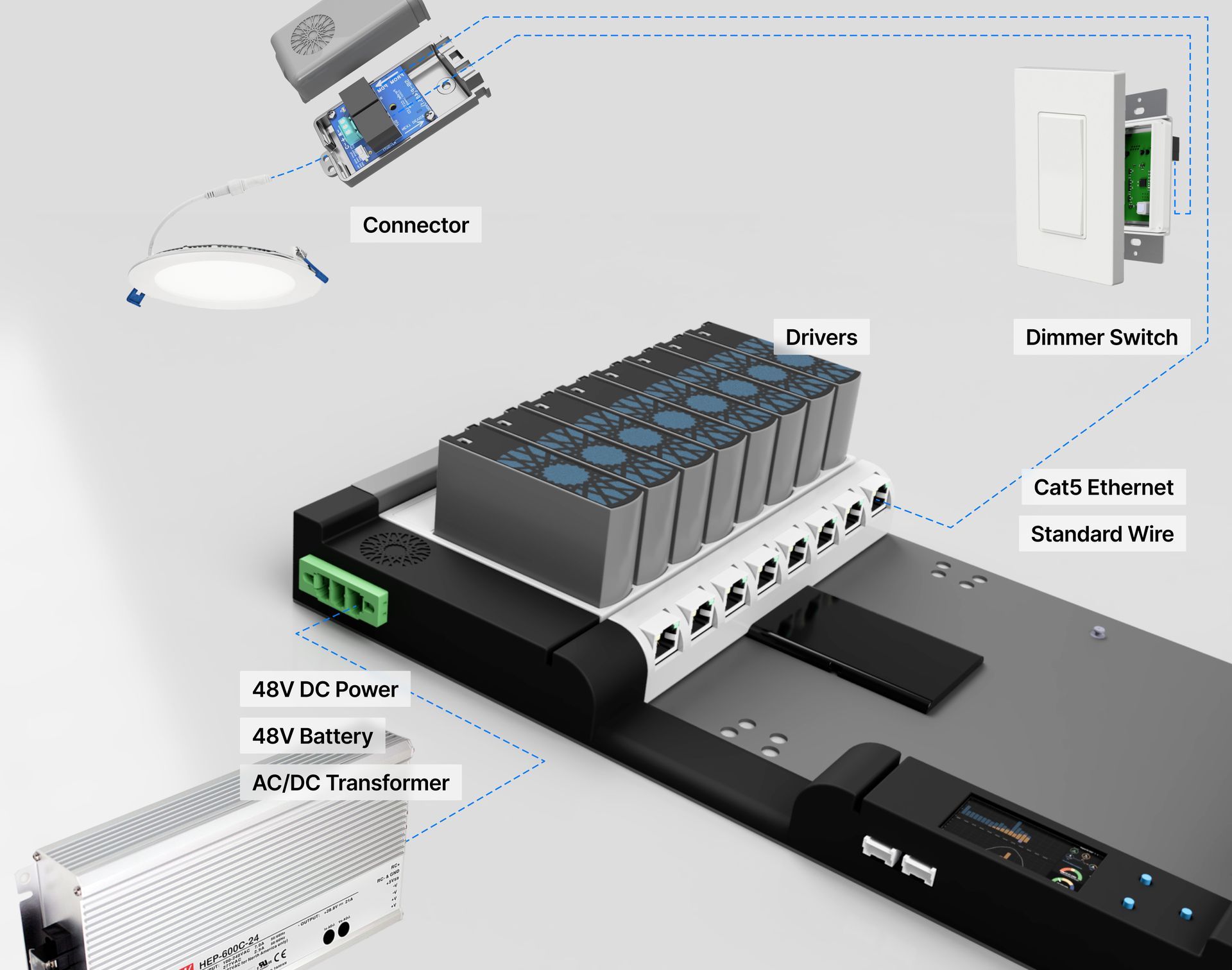
There is a true cost savings on the job. Labor is faster. Material is lighter. Commissioning is faster. Warranty is cleaner because the driver is in a panel you can open. Client control is better because it is a network, not a pile of independent circuits. If you want a small backup battery, solar, or a whole-house battery later, you are already on DC. You are not converting solar to AC so a can light can convert it back to DC.
What it powers
Any LED lighting we spec works on it. Downlights, tape, decorative, exterior. Plus DC ceiling fans, exhaust fans, sensors, and charging outlets for phones, TVs, and computers. The list keeps growing. That is the point of an open platform. You are not locked into one fixture family for the life of the house.
On ReNetA, LumenCache documents the same idea in hardware language. Like a DALI fixture? Use a DALI socket card. Need a PoE camera? Use a PoE card. Found the right downlight? Add a Smart Interface Block, tell the system what the LED needs, and it is on the network. High-wattage cove or tape above a tall ceiling can be run on #16-2 alongside the Cat5 for current, with Cat5 carrying control. The wire in the wall stays. The room can change.
LumenCache published a field example of three downlights that started as one zone. The client wanted two together and one independent. The crew changed the interface blocks, swapped a card, assigned new zones, and left the cable in the wall. No new switch. No patch in the drywall. That is the flexibility we care about on a custom house, because owners change their minds after they live in the rooms.
How it goes in
An electrician can pull it, but it is not required. A low-voltage integrator can easily do this when installing the home automation and networking since they are already familiar with CAT5/CAT6. We do everything in house for quality control and we do the commissioning with our homeowners at their final walkthrough. It is also DIY-friendly if someone is building or remodeling their own home. Class 2 wiring is the reason. Their plug-and-play write-up discusses the real trade shortage we deal with every day. A Class 2 system enables us to take the lighting layer off the electrician's schedule and onto a crew that already pulls CAT5/CAT6.
The PowerPlane goes where you can open it after closing, the way you would place a structured-media enclosure. We make it easily accessible, not buried somewhere it cannot be worked on. Putting drivers in an A/V closet beats drivers in a high ceiling any day of the week.
The trim-out is really fast. ReNetA can discover what is connected and organize devices into zones and scenes. You still get normal switches on the wall, like any lighting system. Clients who want a keypad or a phone can have that too. The system is platform agnostic. It connects to virtually all automation platforms. The switches work if the Wi-Fi is down. The network is still there if they add Savant, Home Assistant, or whatever they choose later.
Fault-managed power is the quiet part that makes plug-and-play real. Each run is monitored. A fault is isolated instead of becoming a mystery in a junction box that an electrician has to troubleshoot. Derek's fault-managed power article is worth reading if you want to get in the weeds about the architecture. On the job, the simplicity is a big payback. It goes like this: terminate the cable, land the card, the load comes up. Nothing complicated about it, and it just works! That's the best part.
Why this looks like the future of new-home wiring
We keep using it because of cost and material savings, the speed of setup and commissioning, and the flexibility after the house is finished. It is platform agnostic. It can connect with many different systems. Lighting is the obvious first layer. Devices are the rest of the story: fans, sensors, charging, cameras, the low-voltage loads that are already native DC.
New homes are being asked to do more and more as technology and building science come into play. Better lighting. Backup power. Solar. Healthier indoor air. Controls that still work in ten years. The old answer is more separate systems and more copper. LumenCache's bet, and ours after close to 30 houses, is that the house should run on one DC network that those products plug into. ReNetA is built so the infrastructure outlives the module. Swap a card when the fixture technology changes. Keep the cable.
That is why I think it can be a big player in how new homes get wired for lighting and devices. Not because of a pretty app, but because the physics and the jobsite both point the same direction.
For the rest of how we think about the envelope and the backbone, see what energy efficient actually means when we build it, high-performance homes, and our older home automation overview. Lighting load is one piece. This is the piece we stopped treating like 1960s wiring with LED bulbs screwed in at the end.
Frequently asked questions
What is LumenCache in a custom home?
A low-voltage DC network that feeds lighting and compatible devices over Cat5/6 from a central panel. UrbanLUX has installed it in close to 30 custom homes, from Gen 1 and LibRE to ReNetA. Read the current platform on lumencache.com/home.
What can it power besides lights?
LED lighting of the kinds we spec, plus DC ceiling fans, exhaust fans, sensors, and charging for phones, TVs, and computers. PoE devices and 12V/24V tape are on the same architecture. Heavy line-voltage appliances stay on the AC panel.
Who installs it?
An electrician can pull it. A low-voltage integrator usually does. Owner-builders can run it. We pull it in-house with our home automation wiring. The AC feed to the panel is still an electrical connection. The lighting and device layer is Class 2.
Does it work with home automation?
Yes. You get normal wall switches. It also connects to virtually all automation platforms. Spec the backbone first. Add the control layer the client actually wants.
Can it run on solar or a backup battery?
Yes. The system is already DC. A small backup battery, solar, or a whole-house battery can support lighting and devices without converting everything back to line voltage. On that 8,800 square foot house, the lighting and fan load was small enough to sit on an alarm battery.
Does this actually save money?
Yes. Less copper, faster labor, faster commissioning, and fixtures and drivers that last longer than retrofit LED products. Compare a real takeoff. The savings are in the wiring method and the service life, not in a cheaper can light.
If you want this in the house
We spec LumenCache because it makes sense. Labor. Cost. Ease of install. Warranty. Client control. A path to solar and backup that does not fight the lighting layer. Close to 30 houses in, we are still installing it, now on ReNetA.
If you are starting a custom home in San Antonio, Boerne, or the Hill Country, talk to UrbanLUX while the lighting and low-voltage plan is still a drawing. For product specs, training, and the current hardware, start at lumencache.com.
Read on.

What "Energy Efficient" Actually Means When We Build It (And Why Most Builders Won't Show You the Numbers)
An energy efficient custom home in San Antonio and the surrounding Hill Country, the way UrbanLUX builds it, hits three specific numbers — and the test report goes to the homeowner at closing. Here's what those numbers mean and why most builders won't show you theirs.
Read
The Best Home Automation To Make Your Life Easier
Automating your home is one of the easiest ways to bring technology and convenience to your lifestyle.
Read
High Performance Homes in San Antonio: 10 Things We Learned Building 200+ of Them
We've built 200+ high performance custom homes in San Antonio — here's what we've learned about energy efficiency, air filtration, smart home systems, and the details that separate a good home from one that saves you thousands every year.
Read